Cost
EVs cost less to drive and maintain than gas-powered vehicles. Click the icon to access a fuel savings calculator and other resources from Plug-in NC to see how much you can save by driving electric.

From a better driving experience to exciting technology and reduced emissions, learn how North Carolina’s electric cooperatives are bringing the benefits of electric vehicles to member-consumers statewide.
North Carolina’s electric cooperatives can answer common questions you have about EVs and debunk myths about them. Whether you’re a homeowner considering purchasing an EV or a company thinking about electrifying your fleet, the cooperatives are a trusted energy partner.

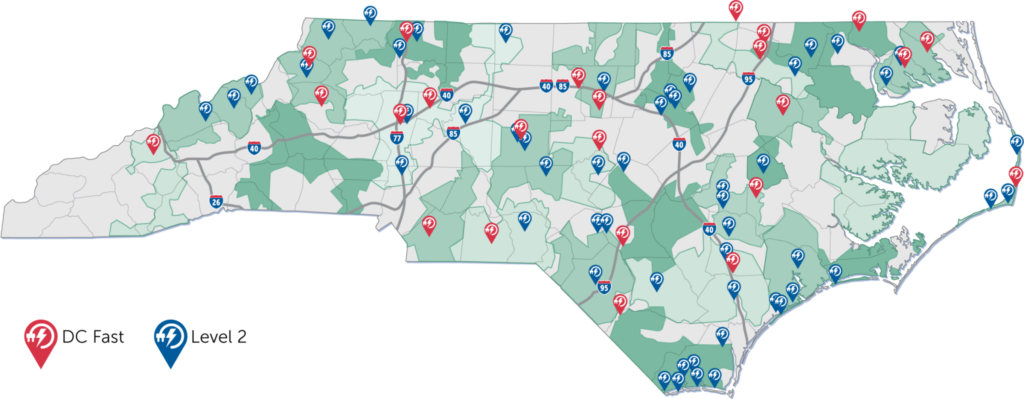
Electric cooperatives have installed charging stations across North Carolina so that no matter where you are, you can reach your destination. Because cooperative communities are located in some of the most beautiful parts of the state, you’ll be able to enjoy the scenery from the mountains to the sea. Level 2 and DC Fast electric vehicle charging station sites are available across cooperative territories.
Fully battery electric vehicles (BEVs) are powered by electric energy stored in the battery only. BEVs have no tailpipe emissions and refuel solely from charging.
Plug-in hybrid electric vehicles (PHEVs) are different than traditional hybrids. PHEVs can be charged and travel fully on electric power before switching over to gas, whereas traditional hybrids convert gas to electric.
From compact sedans to full-sized SUVs to pickup trucks, there is a style of EV to meet a variety of needs. To learn more about which EV models are available in North Carolina, in addition to their estimated range and cost, visit Plug-in NC.
There are three levels of charging for EVs—Level 1, Level 2, and Level 3, also known as DC fast chargers.
Level 1 charging via a 120V outlet is the slowest form of charging and adds 2-5 miles of range to the battery every hour. Level 2 charging is common for homes and workplaces, and will fully charge an EV in 4-10 hours.
DC fast charging is ideal for road trips or quick charging if at-home charging is unavailable. A DC fast charger can fully charge some EVs in as little as about 20 minutes; however, this depends on the power output of the charger and the uptake capability of the vehicle. Both chargers and vehicles contain quickly evolving technology that shortens DC fast charging time.
Some EV chargers are capable of discharging energy from the vehicle to a building or even back to the grid. This technology, called vehicle-to-everything or “V2X,” is in its infancy but could be beneficial for certain applications once commercially viable.
Charging at home is a safe and easy option for most EV owners. If your commute is less than 40 miles per day or if you have access to workplace charging, a standard 120V wall outlet is likely all you need. If you have a longer commute or frequently travel longer distances, consider installing a Level 2 charger.
Check your local electric cooperative’s website as they may have rates or programs for home charging.
As with all electronic devices, there are steps you can take to maximize safety. Make sure that your charger is certified for EV use by a nationally recognized laboratory, such as Underwriters Laboratory (UL Listed). These marks mean the device has been tested in a government-certified lab and meets safety standards.
EV charging cords are designed to be durable, but care should be taken to make sure cords are out of walking areas to minimize tripping hazards. Most residential chargers are installed in garages, but if you plan to install your charger outdoors, look for a charger rated for outdoor use.
Charging at home is typically the most convenient and affordable option to charge an EV. Charging costs about $3 to $5 per 100 miles at home, while charging at a DC fast charger is typically $10 to $15 per 100 miles.
In addition to charging at home or on a road trip, many workplaces have begun offering free workplace charging.
While home energy use is expected to increase significantly as a result of EV adoption, utilities are well-equipped and planning for the increase. Peak demand for electricity typically occurs during the afternoon and early evening hours in summer and during the early morning hours during winter.
Charging during the overnight hours will help mitigate additional spikes in demand, and many utilities, including electric cooperatives offer incentives to consumers to charge when it’s best for the grid. Check your local cooperative’s website to learn more about EV programs they may offer.
Fact: Cold weather causes EVs to have reduced range. The published range for EVs is often the average across seasons, so you may get more range in warmer months and less during colder months. Cold weather will not render an EV unusable, but the range impact could be noticeable on the coldest days of the year.
In addition to the reduced range, the charging uptake rate may be slower so it’s recommended to precondition an EV before charging. A benefit to having an EV during cold weather is the car heats very quickly because there is not an engine that needs to heat up.
Fact: While most drivers want the refueling experience of an EV to mimic that of an internal combustion vehicle, the refueling experience can be more convenient for some. For example, if you left the house with a quarter tank of gas, you may not make it all the way to your destination and need to stop at the gas station. With an EV, you would leave the house with a fully charged battery and would likely reach your destination, where you could charge again without needing to stop along the way.
When longer trips arise, most EVs will suggest charging stations along your route on the onboard console along with estimated charge time to get enough range to reach your destination. The driver would not need to fully charge since they can typically charge when they reach their destination. The number of chargers has exponentially increased over the last five years and there will be a nationwide deployment of DC fast chargers along Alternative Fuel Corridors at least every 50 miles by 2027.
Fact: There is limited data on this topic and more work needs to be done, but from the best data available, EVs are not more likely to catch fire compared to their internal combustion engine counterparts. Lithium-ion batteries are not a new technology — they are in our phones, laptops, power tools and a growing number of other applications. EVs are a newer application for batteries, but we have a good sense of what they are capable of and how to use them safely. Like any technology, follow the manufacturers’ suggestions for charging and repairs to ensure safety.
When they do occur, EV fires can be more difficult to put out than internal-combustion engine fires due to “thermal runaway,” which occurs when temperatures within a lithium-ion battery increase rapidly, according to the Raleigh-based energy consultant Advanced Energy.
Most states (including North Carolina) and automakers are developing training programs for first responders so they are well-equipped to handle the EV transition. North Carolina’s electric cooperatives support these programs and host training sessions for first responders in rural areas.
Fact: According to the U.S. Department of Energy, between 2016 and 2019, about 90% of the lithium imported to the U.S. came from Argentina and Chile, while cobalt, graphite and nickel arrived from a more diverse array of countries, including Canada, Norway, China, the Democratic Republic of Congo and Mexico. Lithium and nickel had a net import reliance of approximately 50%, while 76% of cobalt and 100% of graphite were imported.
With that overseas reliance in mind, a push is being made to have more domestic production and assembly of batteries (13 U.S. battery gigafactories are planned to be online by 2025), including securing domestic raw materials or reducing the need for materials that can’t be locally sourced. The batteries in EVs are not typically destined for a landfill. After their long lives in an EV, there are a couple of options.
The first and currently most common use for end-of-life EV batteries is to repurpose and reuse them. Most commonly, EV batteries are being reused for utility-scale energy storage since they typically have 75% or more of their capacity remaining. Current-day EV batteries are primarily lithium-based, which is an easily recyclable material. The current design of EV batteries are not typically well-designed for recycling, but vast investments have been made towards improving battery design and recycling technology. Expanded U.S. recycling practices should also reduce our dependence on imports.
EVs aren’t just for personal use; in fact, fleets make an excellent use case for electrification. In addition to light-duty vehicles, electric versions of a variety of medium- and heavy-duty vehicles are already on the road. North Carolina’s electric cooperatives have supported several organizations in their fleet electrification efforts.
Fleet “vehicles” aren’t just limited to cars – they can include tractors and trucks, too. As the power providers for much of rural North Carolina, NC’s electric cooperatives work with their agricultural members to find solutions that reduce emissions and costs for their businesses.
Surry-Yadkin Electric Membership Corporation, Hollar & Greene Produce and North Carolina’s Electric Cooperatives launched an innovative, collaborative beneficial electrification project that is helping reduce carbon dioxide emissions and provide a more energy efficient way to transport produce. The eTRU project, which stands for electric transport refrigeration unit, uses electricity to power refrigeration units used for cold-storage shipping instead of diesel.
In partnership with the North Carolina Zoo and Randolph EMC, NC Electric Cooperatives is conducting a demonstration pilot of a Solectrac e25 full electric tractor. During the pilot, the NC Zoo’s horticultural staff will use the tractor throughout the zoo’s 500 developed acres.
Watch the electric tractor at the NC Zoo in action

Email us: BESTsolutions@ncemcs.com